In Text Citation Meaning: What Is It and How Do You Use It?
Have you ever written an assignment but struggled to show where your information came from? Missing or incorrect citations can confuse readers, weaken your arguments, and lead to plagiarism concerns. Understanding the in-text citation meaning makes academic writing much easier. This guide explains citation formats, APA and MLA rules, practical examples, and simple methods to credit your sources correctly and confidently.
What Is the In Text Citation Meaning?
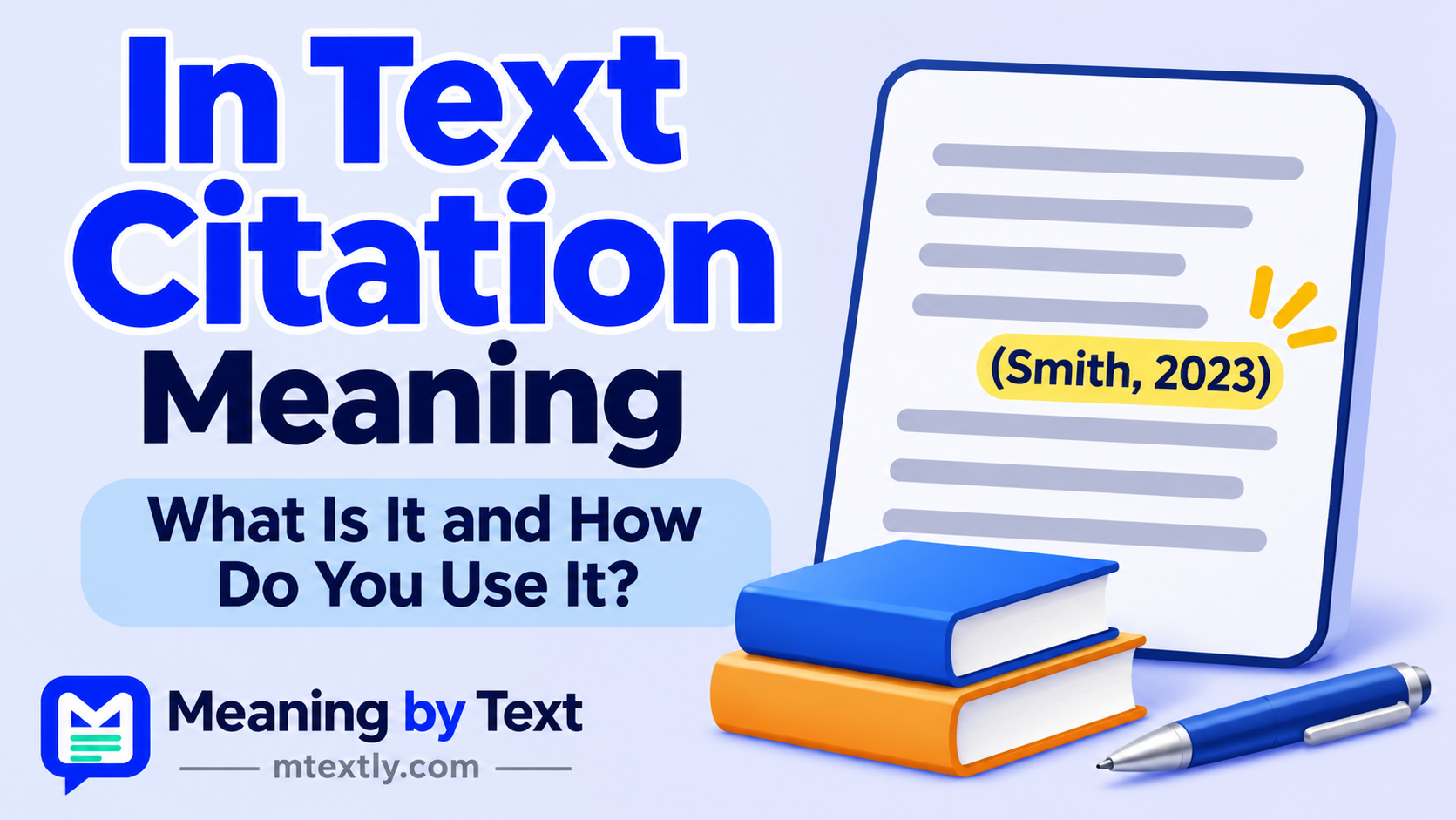
An in-text citation is a short reference placed within a piece of writing that identifies the original source of information, ideas, or quotations. It helps readers find the complete source details in a reference list or Works Cited page.
An in-text citation usually contains the author’s last name, publication year, page number, or a combination of these details, depending on the citation style.
Example:
Regular reading can improve vocabulary and comprehension (Smith, 2024).
Here, Smith represents the author’s surname, while 2024 indicates the publication year.
Simply put, an in-text citation tells readers where you found your information without interrupting the flow of your writing.
In Text Citation Meaning at a Glance
The following table explains the essential features of in-text citations.
| Feature | Explanation |
| Meaning | A brief reference within written content |
| Main purpose | To acknowledge the original source |
| Common formats | APA, MLA, and Chicago author-date |
| Placement | Near borrowed information |
| Author information | Usually the author’s surname |
| Publication year | Required in APA author-date citations |
| Page number | Used according to citation style and source type |
| Full source details | Reference list or Works Cited page |
| Common uses | Essays, research papers, reports, and dissertations |
| Main benefit | Supports academic integrity and source verification |
All sample authors, titles, quotations, and publication details used in this guide are fictional teaching examples unless otherwise stated.
Why Are In-Text Citations Important?
Understanding the in-text citation meaning helps students, researchers, and professional writers present information responsibly.
When you borrow an idea from another writer, a citation separates their contribution from your own thoughts.
In-text citations help you:
- Give credit to original authors.
- Avoid unintentional plagiarism.
- Support arguments with evidence.
- Improve the credibility of your writing.
- Help readers locate original research.
- Maintain academic honesty.
- Demonstrate responsible research practices.
Citations also allow readers to check whether your sources genuinely support your statements. However, adding a citation does not automatically make an unreliable source trustworthy.
What Are the Two Main Types of In-Text Citations?
The two main forms of in-text citations are parenthetical citations and narrative citations.
Both communicate source information, but they place that information differently within a sentence.
Parenthetical citation
A parenthetical citation places the relevant source details inside parentheses.
Example:
Daily writing practice can improve communication skills (Johnson, 2023).
This format keeps the focus on the information rather than the researcher.
Narrative citation
A narrative citation incorporates the author’s name directly into the sentence.
Example:
Johnson (2023) suggests that daily writing practice can improve communication skills.
This format works well when you want to emphasize the author or discuss a particular research finding.
| Feature | Parenthetical citation | Narrative citation |
| Author placement | Inside parentheses | Within the sentence |
| APA example | (Smith, 2024) | Smith (2024) |
| Main emphasis | Information | Author |
| Common use | Supporting statements | Discussing research |
| MLA example | (Smith 25) | Smith explains the idea (25). |
How to Write an In-Text Citation Correctly
You do not need to memorize every citation rule before starting an assignment. First, identify the required citation style and collect the necessary information from your source.
Follow these five steps:
- Identify the original author or responsible organization.
- Find the publication date when your citation style requires it.
- Record the page number or another suitable location for the borrowed information.
- Format the citation according to APA, MLA, or your required style.
- Add the complete source details to the appropriate reference list.
For example, imagine you found useful information on page 42 of a book written by James Wilson in 2024.
Your APA citation for a direct quotation would be:
(Wilson, 2024, p. 42)
Your MLA citation would be:
(Wilson 42)
Both citations identify the same fictional source, but they follow different formatting rules.
In Text Citation Meaning in APA 7th Edition
The American Psychological Association uses an author-date citation system. This format commonly appears in psychology, education, social sciences, and related academic subjects.
In APA 7th edition, a standard in-text citation generally includes the author’s surname and publication year.
APA citation for one author
Parenthetical: (Smith, 2024)
Narrative: Smith (2024)
APA citation for two authors
Parenthetical: (Smith & Brown, 2024)
Narrative: Smith and Brown (2024)
APA citation for three or more authors
Parenthetical: (Smith et al., 2024)
Narrative: Smith et al. (2024)
The abbreviation et al. means “and others.” APA normally uses it from the first citation of a work with three or more authors, unless this creates confusion between sources.
APA citation for a direct quotation
Smith (2024) explains that “consistent practice strengthens learning habits” (p. 18).
When directly quoting a paginated source, include the relevant page number.
In Text Citation Meaning in MLA 9th Edition
The Modern Language Association uses an author-page citation system. Students commonly use MLA style in literature, language studies, and humanities assignments.
Unlike APA, MLA does not normally require the publication year inside a standard in-text citation.
MLA citation for one author
(Smith 25)
MLA citation for two authors
(Smith and Brown 25)
MLA citation for three or more authors
(Smith et al. 25)
MLA narrative citation
Smith explains that consistent reading can develop language skills (25).
Notice that MLA does not normally place a comma between the author’s name and page number.
It also omits the abbreviations p. and pp. from standard author-page citations.
What Is an In-Text Citation in Chicago Style?
The Chicago Manual of Style offers two main citation systems: notes and bibliography, and author-date.
The Chicago author-date system places the author’s surname and publication year within the text. It can also include a specific page number.
Example:
(Smith 2024, 35)
The notes and bibliography system generally uses superscript numbers that direct readers to footnotes or endnotes.
Always check which Chicago system your instructor or publisher requires before preparing your citations.
APA vs MLA vs Chicago In-Text Citation: Detailed Comparison
Understanding the in-text citation meaning becomes easier when you compare the major academic styles side by side.
| Citation situation | APA 7 | MLA 9 | Chicago author-date |
| One author | (Smith, 2024) | (Smith 25) | (Smith 2024) |
| Two authors | (Smith & Brown, 2024) | (Smith and Brown 25) | (Smith and Brown 2024) |
| Three authors | (Smith et al., 2024) | (Smith et al. 25) | (Smith et al. 2024) |
| Direct quotation | (Smith, 2024, p. 25) | (Smith 25) | (Smith 2024, 25) |
| Multiple pages | (Smith, 2024, pp. 25–27) | (Smith 25–27) | (Smith 2024, 25–27) |
| Website without page numbers | (Smith, 2024) | (Smith) | (Smith 2024) |
| Publication date unavailable | (Smith, n.d.) | (Smith 25) | (Smith n.d.) |
| End-of-paper source list | References | Works Cited | Reference list |
| Typical academic fields | Social sciences | Humanities | Sciences and social sciences |
The Chicago examples follow the author-date conventions of the 18th edition. Always use the edition required by your institution.
How to Cite Different Types of Sources
Not every source contains the same information. Books usually have page numbers, while websites and digital videos may require different details.
Here are practical examples for common source types.
| Source type | APA example | MLA example |
| Book | (Wilson, 2024, p. 45) | (Wilson 45) |
| Journal article | (Brown, 2023, p. 12) | (Brown 12) |
| Website paraphrase | (Taylor, 2025) | (Taylor) |
| Online news article | (Clark, 2024) | (Clark) |
| Government report | (City Health Department, 2024) | (City Health Department 15) |
| Organization website | (Learning Foundation, 2025) | (Learning Foundation) |
| E-book with fixed pages | (Harris, 2023, p. 30) | (Harris 30) |
| Online video quotation | (Miller, 2025, 2:15) | (Miller 00:02:15–00:02:20) |
For digital sources, use the creator’s name or another appropriate source identifier. Include a timestamp when required to identify a particular moment in a recording.
Never invent missing publication details simply to complete a citation.
How to Write an In-Text Citation for a Website
A website citation generally follows the same basic principles as a book citation. The main difference is that many websites do not have numbered pages.
Imagine you read an online article written by Emma Taylor in 2025.
APA website citation:
(Taylor, 2025)
MLA website citation:
(Taylor)
You should provide the complete website address in the corresponding reference entry rather than inserting a long URL into every sentence.
If an organization wrote the article, use its name as the author when appropriate.
How to Cite a Source Without an Author
Sometimes, a website or article does not identify an individual author. You can still cite the source without making up a name.
First, check whether an organization or institution is responsible for the publication. If there is no identifiable author, use the title or a shortened version of the title according to your citation style.
For example, consider an article titled “Benefits of Daily Reading,” published in 2024.
APA example:
(“Benefits of Daily Reading,” 2024)
MLA example:
(“Benefits of Daily Reading”)
These examples use quotation marks because the source is an article. Standalone works, such as books, generally require italicized titles instead.
How to Cite a Source Without a Date or Page Number
Understanding the in-text citation meaning also involves knowing how to handle incomplete source information.
Citation without a publication date
APA uses the abbreviation n.d., which means “no date.”
Example:
(Smith, n.d.)
MLA does not normally require a publication date in the in-text citation, so its absence does not usually change the citation format.
Citation without a page number
If you directly quote an APA source without page numbers, you can use an appropriate alternative locator, such as a paragraph number.
Example:
(Smith, 2024, para. 5)
In MLA, use available source-supplied section or paragraph numbers when appropriate. If the source has no suitable locator, omit it rather than inventing one.
Example:
(Smith)
What Is the Difference Between an In-Text Citation and a Reference?
An in-text citation identifies the source briefly inside your writing. A reference provides the complete publication details needed to locate that source.
Imagine you are citing a fictional book by James Smith.
APA in-text citation:
(Smith, 2024)
APA reference entry:
Smith, J. (2024). Understanding academic writing. Learning Press.
| Feature | In-text citation | Reference |
| Location | Within the main text | End of the document |
| Length | Short | Detailed |
| Main function | Identifies the source | Helps readers locate the source |
| Information | Author, date, or locator | Author, title, date, and publication details |
| Example | (Smith, 2024) | Complete book or article entry |
Think of an in-text citation as a signpost. The reference list provides the full address.
Most recoverable sources cited in APA should have matching reference entries. Exceptions include personal communications, which readers cannot independently retrieve.
When Do You Need to Use an In-Text Citation?
You need an in-text citation whenever you use another person’s original ideas, research findings, statistics, or written words.
Common situations include:
- Quoting a sentence directly.
- Paraphrasing an author’s argument.
- Summarizing a research study.
- Using published statistics.
- Discussing another person’s theory.
- Referring to original survey results.
- Using information from books or websites.
You generally do not need citations for your own original analysis or widely accepted common knowledge.
For instance, stating that Earth revolves around the Sun usually requires no citation. Reporting the findings of a particular astronomy study does.
How to Cite Direct Quotations and Paraphrased Information
A direct quotation repeats the original author’s exact words. Paraphrasing communicates the same information using your own wording and sentence structure.
Both require appropriate attribution.
Direct quotation example
“Regular practice helps learners develop confidence” (Smith, 2024, p. 18).
Paraphrasing example
Learners may become more confident when they practice consistently (Smith, 2024).
APA requires a suitable locator for direct quotations, while page numbers are generally optional for paraphrases.
MLA includes a relevant page number when citing a specific passage from a paginated work, even when you paraphrase it.
Changing a few words from the original sentence does not automatically create an acceptable paraphrase. Read the source, understand its message, and explain it independently before adding the citation.
Common In-Text Citation Mistakes to Avoid
Even experienced writers make citation mistakes. Most errors happen when writers forget to record source details or combine different citation styles.
| Common mistake | Correct approach |
| Missing publication year in APA | (Smith, 2024) |
| Adding an unnecessary comma in MLA | (Smith 25) |
| Using p. for multiple APA pages | (Smith, 2024, pp. 25–28) |
| Forgetting a locator for an APA quotation | (Smith, 2024, p. 25) |
| Missing the period in et al. | (Smith et al., 2024) |
| Mixing APA and MLA | Follow one required style |
| Inventing a publication date | Use n.d. in APA |
| Missing source attribution | Add an appropriate citation |
| Missing a reference entry | Include complete source details when required |
Check each citation against its original source before submitting your assignment.
Can In-Text Citations Help Prevent Plagiarism?
Yes. Correct in-text citations help prevent plagiarism by acknowledging the original creators of borrowed information.
However, a citation alone does not make every use of another person’s work acceptable. You must also distinguish exact quotations from paraphrases and follow your institution’s academic integrity rules.
Copying an entire paragraph without quotation formatting can still create plagiarism concerns, even when you mention the author.
Understanding the in-text citation meaning helps you develop responsible writing habits that extend beyond completing an assignment.
How to Check Your In-Text Citations Before Submission
Before submitting an essay, research paper, or dissertation, review your citations carefully.
Use this simple checklist:
- Confirm the required citation style.
- Check every author’s surname.
- Verify publication dates.
- Include accurate page numbers or alternative locators.
- Identify all direct quotations.
- Cite borrowed ideas and research findings.
- Match citations with their reference entries.
- Check punctuation and spacing.
- Remove references to sources you have not actually consulted.
Citation generators can save time, but they may produce formatting errors when publication details are missing or inaccurate. Always review their results against the official style guidelines.
FAQ
1. What is an example of an in-text citation?
An APA in-text citation example is (Smith, 2024). An MLA example is (Smith 25). Both identify the original source within your writing.
2. Is APA in-text citation PP or P?
APA uses p. for one page and pp. for multiple pages. For example, (Smith, 2024, p. 10) identifies one page, while (Smith, 2024, pp. 10–15) identifies several pages.
3. Does MLA or APA use in-text citations?
Both MLA and APA use in-text citations. APA generally follows the author-date system, while MLA normally follows the author-page system.
4. What is an in-text citation called?
An in-text citation may take the form of a parenthetical citation or a narrative citation, depending on how the source information appears within a sentence.
5. What is the in text citation meaning in simple words?
An in-text citation is a short note inside your writing that tells readers where you found a particular fact, idea, or quotation.
6. Does every in-text citation need a reference?
Most citations for recoverable sources require a matching reference or Works Cited entry. Exceptions depend on the citation style, such as APA citations for personal communications.
Conclusion
Understanding the in-text citation meaning is an important step toward producing clear, credible, and responsible academic writing. Whether you follow APA, MLA, or Chicago style, every citation should help readers identify the information’s original source.
Start by choosing the correct format, collecting accurate source details, and checking your references before submission. These simple habits can improve your writing and reduce avoidable citation mistakes.
Try creating your next citation manually using the examples in this guide. Once you understand the basic rules, referencing becomes a natural part of writing rather than a difficult final task.
Which citation style do you find easiest to use—APA, MLA, or Chicago? Share your experience in the comments.