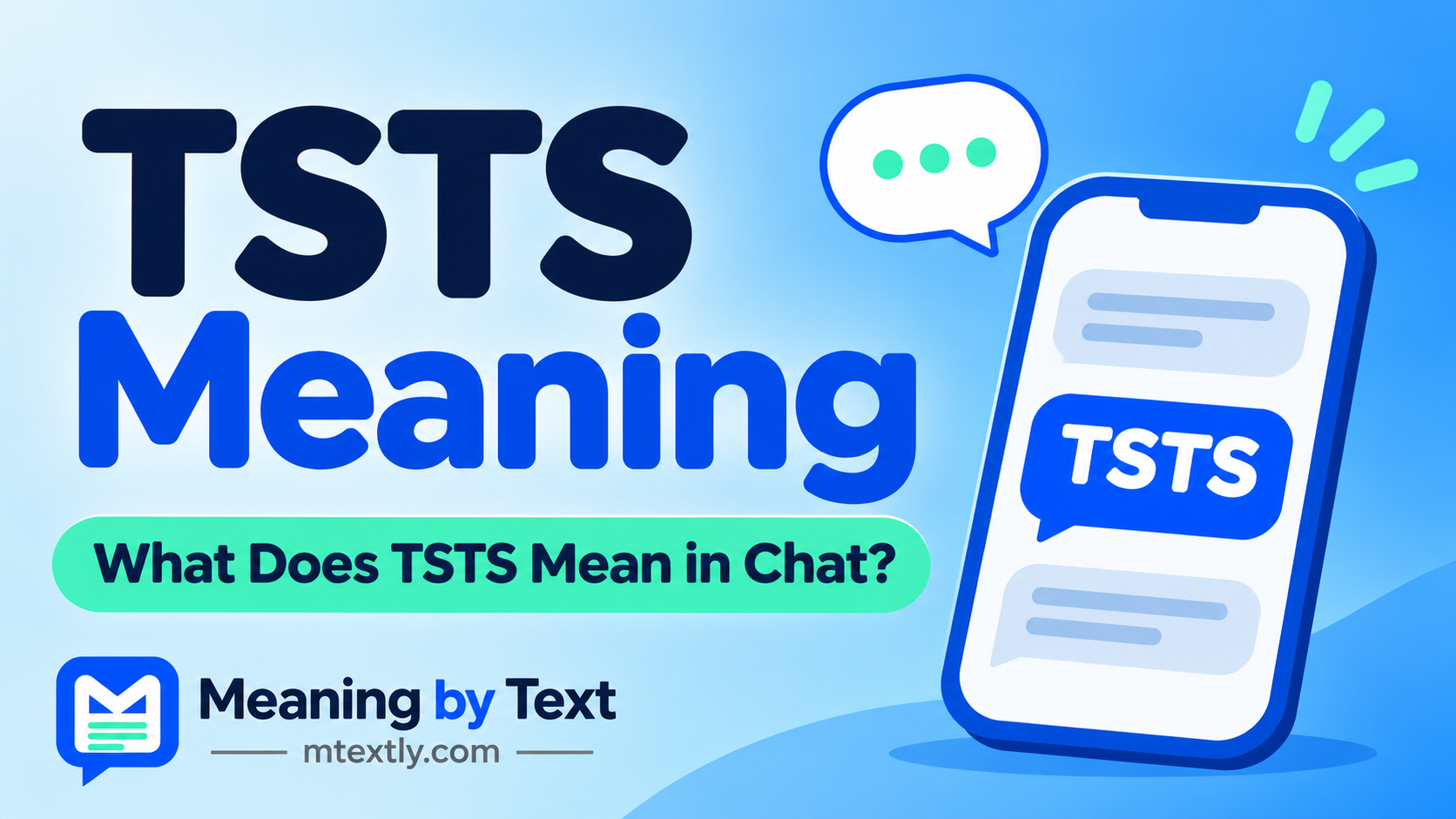
TSTS Meaning in Text: What Does TSTS Mean in Chat?
You open a message and see “tsts.” Is your friend annoyed, joking, or agreeing with you? Guessing the wrong meaning can make a simple conversation uncomfortable, especially when there are no emojis to explain the tone. Fortunately, tsts meaning in text becomes much easier to understand when you know its different uses and pay attention to the words around it.
What Does TSTS Mean in Text?
TSTS can represent a “tsk-tsk” sound of disapproval or the informal slang expression “type shit, type shit.” These interpretations have different meanings, so the conversation determines which one makes sense.
When someone types TSTS after you admit a small mistake, they might be teasing you or expressing mild disappointment. When they send it after something they agree with, they might be using the second interpretation as a casual acknowledgment.
There is no single, universally accepted expansion of TSTS in everyday texting. The expression can also carry a personal meaning within a particular group of friends.
TSTS Meaning in Text: Quick Reference Table
The following table explains common interpretations, their emotional tone, and the situations in which you might encounter them.
| Expression | Possible Meaning | Typical Tone | Example | What It Communicates |
|---|---|---|---|---|
| TSTS | Tsk-tsk | Playful or disapproving | “You forgot again? TSTS!” | Mild criticism or teasing |
| tsts | Type shit, type shit | Casual or agreeable | “I just want a peaceful weekend.” “tsts” | Agreement or acknowledgment |
| TSTS | Too soon, too serious | Context-specific | “We’re already talking about marriage? TSTS.” | The situation feels too serious |
| ts ts | Tongue-clicking sound | Disappointed or teasing | “Ts ts, you did it again.” | Playful judgment |
| tsss | Extended hissing sound | Annoyed, teasing, or dramatic | “Tsss, that was close!” | An emotional reaction |
| tsk-tsk | Written sound of disapproval | Mildly critical | “Tsk-tsk, that’s not fair.” | Disagreement or criticism |
| TTS | Text-to-speech | Technical | “Turn on TTS.” | A feature that reads text aloud |
| TBBT | The Big Bang Theory | Neutral | “I’m watching TBBT.” | Reference to the television series |
The most important detail about tsts meaning in text is that the expression does not work like a straightforward abbreviation such as LOL or BRB.
Its meaning comes from the situation, rather than the letters alone.
Does TSTS Mean “Tsk Tsk”?
Yes. TSTS can imitate the sound of someone clicking their tongue to show disappointment, criticism, or playful disapproval.
The more familiar spelling is “tsk-tsk.” Cambridge Dictionary identifies “tsk” as a written expression associated with disapproval.
Consider this conversation:
Emma: “I ate the last piece of cake.”
Ryan: “TSTS, and you didn’t save me any?”
Ryan is not necessarily angry. His message may simply be a playful way to point out Emma’s behavior.
This is one of the easiest ways to recognize tsts meaning in text when the conversation involves a mistake, a broken promise, or harmless teasing.
Why Do People Type TSTS Instead of TSK-TSK?
People often spell sounds differently in casual messages. Someone might write “ts ts,” “tststs,” or “tsss” to reproduce a sound they would make while speaking.
There is no strict spelling rule for these informal reactions. A person’s language background and texting habits can influence their preferred version.
Can TSTS Mean “Type Shit, Type Shit”?
Yes. Another documented interpretation of TSTS is “type shit, type shit,” an informal expression used to show agreement or recognition.
The phrase “type shit” may communicate something similar to “I get what you mean,” “that’s the vibe,” or “fair enough.” Repeating it creates the abbreviation TSTS.
For example:
Alex: “I’d rather stay home and play games than go to another party.”
Jordan: “TSTS.”
Jordan may be agreeing with Alex’s preference rather than criticizing it.
User-submitted definitions on Urban Dictionary record this interpretation, including entries from 2022 and 2023. However, those entries show that people have used the expression this way; they do not prove that everyone recognizes it.
Understanding this alternative tsts meaning in text helps explain why the same four letters can produce opposite reactions in different conversations.
What Does TSTS Mean When Someone Is Agreeing?
When TSTS follows an opinion, a personal preference, or a description of someone’s lifestyle, it may express agreement.
For example, a friend might say, “I need a quiet weekend with no plans.” The reply “tsts” could mean the sender understands or relates to that feeling.
Look for other signs of agreement in the conversation. A positive emoji, friendly follow-up, or supportive message can help confirm the intended tone.
In this situation, tsts meaning in text is closer to casual acknowledgment than criticism.
How Does TSTS Express Annoyance or Disappointment?
TSTS can also act as a short reaction when someone feels unimpressed or disappointed. It resembles the sound people make when they shake their heads at questionable behavior.
Imagine this exchange:
Nina: “I promised I’d be on time, but I’m late again.”
Sam: “TSTS. Every single time!”
Sam’s additional words suggest frustration rather than simple agreement.
However, the expression alone does not tell you how upset someone is. A playful friend might use exactly the same letters without feeling angry.
This difference explains why tsts meaning in text should never be interpreted without considering the surrounding message.
What Does TSTS Mean on Snapchat?
On <Entity value=”Snapchat” category=”software” disambig=”social messaging platform”/>, TSTS can appear in private chats, story replies, or conversations between friends.
The meaning does not automatically change because someone uses Snapchat. It still depends on whether the sender is showing agreement, disappointment, or playful judgment.
For example:
Friend: “I broke our Snapstreak because I forgot to reply.”
You: “TSTS 😂”
The laughing emoji makes a teasing interpretation more likely.
When checking tsts meaning in text on Snapchat, pay attention to the emoji, the message being answered, and your usual relationship with the sender.
How Is TSTS Used on Instagram and TikTok?
On <Entity value=”Instagram” category=”software” disambig=”social media platform”/> and <Entity value=”TikTok” category=”software” disambig=”short-form video platform”/>, TSTS may appear in comments, captions, or direct messages.
A person could use it to react to an embarrassing moment, agree with a creator’s opinion, or tease a friend about something funny.
Here are three illustrative examples:
- Funny video: “TSTS 😂 you really did that?”
- Relatable post: “No more drama this year.” Reply: “tsts.”
- Questionable decision: “You spent all your savings?” Reply: “TSTS 😭”
These examples show possible uses, not platform-specific definitions. Neither Instagram nor TikTok gives TSTS one official slang meaning.
The safest approach to tsts meaning in text on social media is to read the entire conversation instead of relying on the letters alone.
What Does TSTS Mean From a Guy or a Girl?
TSTS has no established meaning based on the sender’s gender.
A guy might use it to tease someone about a mistake, while a girl might use it to show casual agreement. The opposite is equally possible.
For example, if someone replies “tsts 😂” after you tell a funny story, they may be joking with you. If they send “TSTS” after you say something serious, you should consider the possibility of annoyance or disagreement.
Don’t assume romantic interest, rejection, or anger from the abbreviation alone.
The person, their usual texting style, and the topic of conversation provide better clues to tsts meaning in text than whether the sender is male or female.
Is TSTS Rude, Friendly, or Flirty?
TSTS is not automatically rude or flirty. Its emotional meaning changes according to the relationship and the conversation.
A close friend can use it affectionately, especially when the message includes laughter or a joking remark. During an argument, the same reaction might sound dismissive.
| Situation | Likely Interpretation | Example |
|---|---|---|
| A friend makes a harmless mistake | Playful teasing | “TSTS 😂” |
| Someone shares a relatable opinion | Agreement | “tsts, I feel you.” |
| A person breaks a promise | Disappointment | “TSTS, you said you’d help.” |
| Two people exchange playful messages | Gentle teasing | “TSTS, you’re impossible 😂” |
| Someone responds to serious news | Potentially dismissive | “TSTS.” |
| A person sends the letters without context | Unclear | “tsts” |
A flirty conversation can make TSTS sound playful, but the expression itself is not a recognized declaration of attraction.
How Should You Reply to TSTS in a Message?
The best response depends on what the sender appears to mean. You do not need a complicated answer.
If the message sounds playful, continue the joke. If it sounds critical, acknowledge the issue or explain what happened.
| If TSTS Means… | You Could Reply… |
|---|---|
| Playful teasing | “Haha, I know 😂” |
| Mild disappointment | “Sorry, I’ll do better next time.” |
| Agreement | “Exactly!” |
| Casual acknowledgment | “You get it!” |
| Friendly criticism | “Okay, you caught me!” |
| Unclear meaning | “Wait, what do you mean by tsts?” |
When you’re uncertain about tsts meaning in text, asking a simple question is usually better than guessing.
A response such as “Are you teasing me or agreeing with me?” can clear up the confusion while keeping the conversation friendly.
What Is the Difference Between TSTS, TS TS, and TSSS?
These expressions look similar, but they do not always communicate the same thing.
TSTS can function as a written sound or as a context-specific abbreviation. It has several informal interpretations, including the agreement-related expression discussed earlier.
TS TS more clearly resembles repeated tongue-clicking. Writers may use it to express disapproval, mild frustration, or teasing.
TSSS typically represents an extended hissing or sharp “s” sound. It can add drama to a reaction, suggest irritation, or imitate the sound someone makes when something surprising happens.
For example:
- “TSTS, you forgot my birthday!” — Possible disappointment.
- “Ts ts, that wasn’t a smart choice.” — Mild criticism.
- “Tsss, that nearly went wrong!” — A dramatic reaction.
The number of letters and the spacing can change how a reader imagines the sound. They do not create a fixed emotional meaning.
What Other Texting Abbreviations Are Confused With TSTS?
Readers sometimes mistake TSTS for similar-looking abbreviations.
TTS commonly means text-to-speech, an accessibility and audio feature that turns written words into spoken audio. It is different from the informal reaction TSTS.
TS is another expression with several slang interpretations, depending on the community. It should not automatically be expanded into TSTS.
TBBT, meanwhile, usually refers to the television sitcom The Big Bang Theory. The abbreviation appears in official Warner Bros. TV social media content and has no direct relationship to TSTS.
Learning the differences can prevent confusion when reading short messages or social media comments.
How Can You Identify the Correct TSTS Meaning From Context?
The easiest way to understand an unfamiliar abbreviation is to look at what happened immediately before it.
Use these four checks:
- Read the previous message. Did someone make a mistake, share an opinion, or tell a joke?
- Check the emotional tone. Laughing emojis may suggest teasing, while serious follow-up words may suggest frustration.
- Consider the relationship. Close friends often use playful expressions that would sound unusual in formal conversations.
- Ask when needed. A direct question prevents misunderstandings when the meaning remains unclear.
For example, a reply to “I forgot our plans” probably carries a different meaning from the same reply to “I prefer quiet weekends.”
A practical understanding of tsts meaning in text comes from these clues, not from memorizing a single definition.
Realistic TSTS Text Conversation Examples
The following sample conversations demonstrate how the expression might work in everyday messages.
Example 1: A Playful Warning
Mia: “I promised not to eat sweets today.”
Leo: “And you bought three donuts? TSTS 😂”
Here, Leo is playfully criticizing Mia for breaking her promise.
Example 2: Casual Agreement
Ben: “I just want to finish work, get home, and relax.”
Chris: “tsts.”
Chris may be acknowledging Ben’s mood or agreeing with his preference.
Example 3: Mild Disappointment
Ava: “Sorry, I forgot to call you yesterday.”
Noah: “TSTS. I waited all evening.”
Noah’s follow-up message suggests that he feels disappointed.
Example 4: Friendly Teasing
Lily: “I said I wouldn’t text him again.”
Sophie: “TSTS, and here we are 😂”
Sophie uses the expression to tease Lily about changing her mind.
Example 5: An Unclear Reply
Jake: “I might skip the party tonight.”
Taylor: “tsts.”
Without more information, Taylor could be agreeing, disapproving, or using an inside joke.
These examples demonstrate why tsts meaning in text is closely connected to the conversation rather than a single universal definition.
Why Do People Use Short Reactions Instead of Full Sentences?
People use short reactions because they can communicate emotion without requiring a long message.
Sounds such as “hmm,” “ugh,” “tsk,” and “psst” represent feelings or actions through writing. Linguists call words that imitate sounds onomatopoeia.
TSTS can work in a similar way when someone wants to imitate a tongue click. The agreement-related abbreviation works differently because it represents a spoken slang phrase.
This distinction helps explain how one expression can have more than one interpretation.
FAQ
1. What is the meaning of TSTs?
Short answer: In casual texting, TSTS may represent a disapproving “tsk-tsk” sound or the phrase “type shit, type shit.”
The intended meaning depends on context. In other fields, capitalized TSTs may represent a plural technical abbreviation, so the subject of the message matters.
2. What does ts ts mean in text?
Short answer: “Ts ts” usually imitates a repeated tongue-clicking sound associated with disapproval, disappointment, or teasing.
For example, someone might write “Ts ts, you did it again!” after a friend repeats a familiar mistake. The tone can be playful rather than angry.
3. What does “tsss” mean in slang?
Short answer: “Tsss” is usually a written sound that may suggest hissing, annoyance, tension, or a dramatic reaction.
Someone might type “Tsss, that was close!” after narrowly avoiding a problem. Its emotional meaning depends on the surrounding words.
4. What does TBBt mean in texting?
Short answer: TBBT usually stands for The Big Bang Theory, the American television comedy.
People use it when discussing episodes, characters, or memorable scenes from the show. It is not another spelling of TSTS.
5. Is TSTS the same as TSK TSK?
Short answer: Sometimes, yes. TSTS can imitate the same disapproving sound represented by “tsk-tsk.”
However, TSTS also has other documented slang interpretations. You should check the context before treating the expressions as identical.
6. Does TSTS always mean someone is upset?
Short answer: No. TSTS can express playful criticism, casual agreement, disappointment, or another meaning understood by the people chatting.
A laughing emoji or supportive follow-up often changes the tone. The safest interpretation comes from the conversation as a whole.
Final Thoughts: Understand TSTS Before You Reply
The main lesson about tsts meaning in text is simple: four letters do not always tell the whole story. TSTS may represent mild disapproval, playful teasing, or an informal expression of agreement.
Instead of assuming someone is upset or agreeing with you, read the message that came before it. Notice the emojis, punctuation, and the sender’s normal style.
The next time you receive “TSTS,” use the examples in this guide to understand the likely meaning. And if it still seems unclear, ask what the person meant. A quick question can prevent an unnecessary misunderstanding.